


Executive Summary
USP Chapter <781> Optical Rotation was officially revised on November 22, 2024. The new requirements introduce significantly more detailed guidance for the qualification, calibration, and ongoing verification of polarimeters used in pharmaceutical laboratories.
The changes affect:
- Polarimeter qualification (IQ/OQ/PQ)
- Accuracy verification
- Repeatability testing
- Linearity verification / Sample Bracketing
- Temperature validation
- Quartz Control Plate (QCP) calibration and traceability
- Multi-point calibration requirements across the user’s operational testing range
For pharmaceutical manufacturers, contract laboratories, and quality control groups, compliance now requires a more structured approach to polarimeter qualification than previously described in USP <781>

Qualification of Polarimeters Added
New section establishes IQ,OQ, and PQ requirements for polarimeters
Ensures instruments are installed correctly and perform as intended.

Temperature Validation Required
Temperature control must be verified and maintained
OQ must demonstrate temperature accuracy within ±0.5°C and be traceable to NIST.

Accuracy across operational range
Accuracy of optical rotation must be verified at three or more values
Covers the user’s operational range, not just a single point

Repeatability Requirements Clarified
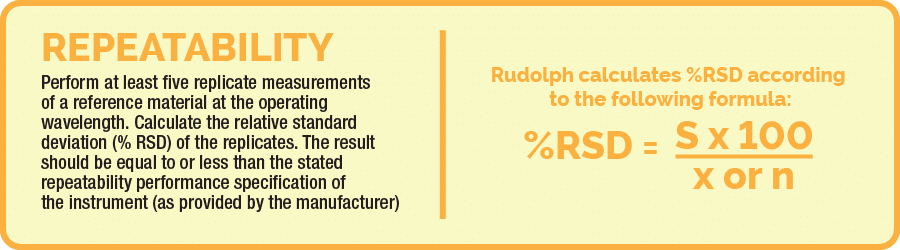
At least five replicate measurements with % RSD calculated.
Results must meet manufacturer repeatability

Linearity Verification
Linearity must be verified at three or more values representing the operational range.
Ensures reliable quantitative results

Certified Reference Materials
QCPs must be calibrated by an NMI or ISO/IEC 17025 accredited laboratory.
Strengthens traceability and measurement confidence.

What Changed in USP <781>?
The most significant addition is an entirely new performance qualifications for polarimeters.
IQ-OQ-PQ Polarimeter Qualification Flow
A complete lifecycle approach to polarimeter qualification per USP <781>
IQ INSTALLATION QUALIFICATION

Verify hardware and software are properly installed.

Confirm environmental conditions (temperature and humidity)

Review installation checklist and documentation.

OQ
OPERATIONAL QUALIFICATION

Verify temperature control
(Accuracy within ± 0.5°C)

Verify wavelength accuracy and bandwidth

Verify optical rotation accuracy at three or more values (bracketing)

Verify repeatability (at least five replicates, %RSD).

PQ
PERFORMANCE QUALIFICATION

Periodically verify optical rotation accuracy and linearity

Verify repeatability
(at least five replicates)

Verify temperature control performance

Establish and follow ongoing verification frequency


USP redefines OQ and PQ qualification requirements:
Installation Qualification (IQ) – Unchanged
Verification that the instrument hardware and software are properly installed and environmental conditions are acceptable.
Operational Qualification (OQ) – Adjusted
Verification that the instrument performs correctly and includes:
- Optical rotation accuracy verification
- Repeatability verification
- Wavelength accuracy verification
- Temperature control verification
Performance Qualification (PQ) – Significant
Periodic verification of:
Suitability of use, utilizing customer samples and analysis. Cell must be filled, temperature control enabled, sample measured successfully.
Change #1: Who Can Supply and Calibrate Quartz Control Plates?
The revised USP language specifically states that Certified Quartz Control Plate Polarization Reference Standard should be used for Polarimeter Validation and Calibration and that both Calibration and Re-Calibration of these Quartz Control Plate Reference Materials must be performed by:
- A National Metrology Institute (NMI), or
- A laboratory accredited to ISO/IEC 17025 through an ILAC-MRA recognized accreditation body.
The USP Says:
“Qualification may be performed using a polarization reference standard, which consists of a plate of quartz mounted in a holder perpendicular to the light path. Acceptable periodic calibrations may be made by a National Metrology Institute (NMI) that is signatory to the International Committee for Weights and Measures Mutual Recognition Arrangement (CIPM MRA) or an ISO/IEC 17025 accredited laboratory for calibration where the accreditation body is a signatory to the International Laboratory Accreditation Cooperation Mutual Recognition Arrangement (ILAC MRA).”
How Rudolph Meets These New Manufacture Calibration Requirements Polarimeter manufacturers providing Quartz Control Plates operate under ISO 17025 and manufacture Quartz Reference Material to comply with ISO 17034
Example Quartz Control Plate (QCP) Certificate

Change #2: Linearity / Sample Bracketing Calibration Is Now Required
The USP Says:
“Linearity is verified if three or more optical rotation values representing the operational range meet the criteria for accuracy.”

3 Rotation Standard Quartz Plate

How it Works
The plate consists of three quartz elements. The left element is +11.998° Arc, the center element is +0.998° Arc, and the right element is -11.000° Arc
Combined rotation = +11.998° + 0.998° – 11.000° = +0.998° Arc
Understanding Optical Rotation vs. Specific Rotation
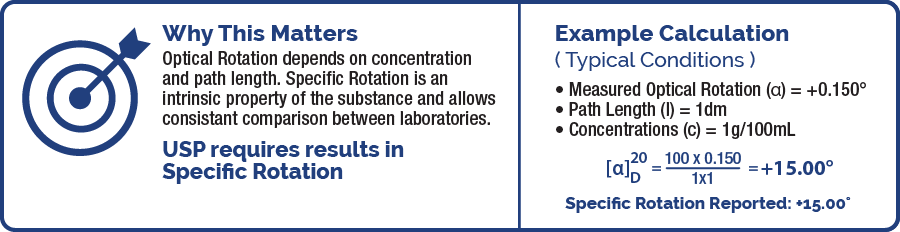
One of the most common misconceptions in polarimetry is the difference between Optical Rotation and Specific Rotation. While USP monographs almost always specify acceptance limits in Specific Rotation, the polarimeter itself directly measures only Optical Rotation.
Optical Rotation (α) is the actual angular rotation of polarized light caused by a sample. This measured value depends on several factors, including the concentration of the sample, the optical path length of the measurement cell, the wavelength of light used, and the sample temperature. The polarimeter measures this optical rotation directly and reports it in degrees Arc.
Specific Rotation, however, is a normalized value that removes the effects of concentration and path length so that results can be compared consistently between laboratories. USP monographs specify acceptance criteria in Specific Rotation because it represents an intrinsic property of the material rather than a measurement that depends on how the sample was prepared. USP <781> defines the relationship between Optical Rotation and Specific Rotation as:

From Optical Rotation to Specific Rotation:
How your Polarimeter Delivers USP Monograph Results

Sample Preparation
Prepare sample as required by the USP monograph. Typical pharmaceutical concentration : 10 mg/mL (1g /100mL.


Polarimeter Measures Optical Rotation
The instrument measures the actual rotation (α) of plane polarized light caused by the sample.


USP Formula Applied
The polarimeter automatically applies the USP equation to convert the measured optical rotation to specific rotation.


Specific Rotation Reported
The result is reported as Specific Rotation, which is what USP monographs specify.


Change #3: Verification Must Cover the User’s Operational Range
USP now specifically states:
“Linearity should be verified at three or more values representing the operational range.”
USP requires verification at multiple optical rotation values representing the instrument’s operating range.
This means calibration can no longer rely on a single quartz standard. A compliant qualification should include:
What Is Operational Range?
The operational range is the range of optical rotation values the samples under test that are measured in the laboratory.
Examples:
User A
Measures products between:
+0.5° and +3°
Their qualification must verify this region.
User B
Measures products between:
-10° and +12°
Their qualification must verify this broader range.
Why This Matters
Many laboratories currently verify performance at only one quartz value.
The revised USP guidance now expects verification at multiple points spanning actual use conditions.
Change #4: Temperature Validation Is Now Explicitly Required
The new USP section identifies temperature control as a critical component of polarimeter qualification.
USP states that:
- Optical rotation is affected by sample temperature.
- Temperature must be controlled and monitored.
- OQ should demonstrate temperature accuracy within ±0.5°C.
- Verification should be traceable to NIST standards.
Why Temperature Matters
Small temperature deviations can create measurable optical rotation errors.
How Rudolph Addresses Temperature Validation
Rudolph offers:
- TempTrol™ temperature validation cells
- Traceable temperature verification systems
- Automated temperature reporting
The system allows users to validate:
- Polarimeter temperature control
- Cell temperature performance
- Compliance with USP temperature requirements at ±0.2°C
TempTrol™ Validation Cell


In Conclusion
USP now requires:
- At least five replicate measurements
- Calculation of %RSD
- Results meeting manufacturer repeatability specifications.
Rudolph documentation explains that %RSD varies with optical rotation value and demonstrates repeatability calculations at multiple optical rotation levels.
Change #6: Recalibration of Quartz Control Plates
USP’s increased emphasis on certified reference materials means laboratories should establish documented recalibration intervals for their Quartz Control Plates.
In addition it is advisable to use a Polarimeter from a manufacturer who can also supply and recertify Quartz Plates and is accredited to by ISO/IEC 17025 and 17034
From USP <781> Requirement to Compliant Polarimeter Calibration
A Traceable Path to Accuracy and Compliance


Conclusion
The November 22, 2023 revision to USP <781> establishes a new standard for polarimeter qualification. Laboratories are now expected to verify performance using certified reference materials, validate temperature control, perform repeatability studies, and demonstrate accuracy across their actual operating range.
Rudolph Research Analytical’s ISO 17025 accredited calibration services, certified Quartz Control Plates, IQ/OQ/PQ documentation, and temperature validation solutions provide a complete pathway to USP <781> compliance.