
A Comparative Analysis of Manual vs. Automated Workflows in Liquid Product Laboratories
परिचय
Laboratory sample automation, why? Laboratories analyzing liquid-based products—such as flavors, fragrances, beverages, liquid foods, and nutraceuticals (including oils and lotions)—are under constant pressure to deliver accurate, repeatable, and compliant results. Each sample often requires multiple analytical measurements to ensure product quality and regulatory adherence. Automated multi-parameter analysis can make 1-5 or more measurements from a single sample. Some widely used instruments are Refractometers to measure measure refractive index (RI/BRIX), Polarimeters to measure optical rotation (specific rotation), Density Meters to measure density or specific gravity, pH, and color.
Traditionally, these measurements are performed using separate instruments, with technicians manually transferring samples between systems. While this approach appears straightforward and cost-effective at first glance, it introduces a range of hidden inefficiencies that significantly impact laboratory performance.
Advancements in laboratory automation – particularly integrated, multi-parameter, laboratory automation systems – are transforming this workflow. By enabling multiple measurements from a single sample load, automation reduces labor, improves data integrity, and increases throughput. This paper explores the true cost of manual sample handling and demonstrates how automation fundamentally changes laboratory economics and performance.
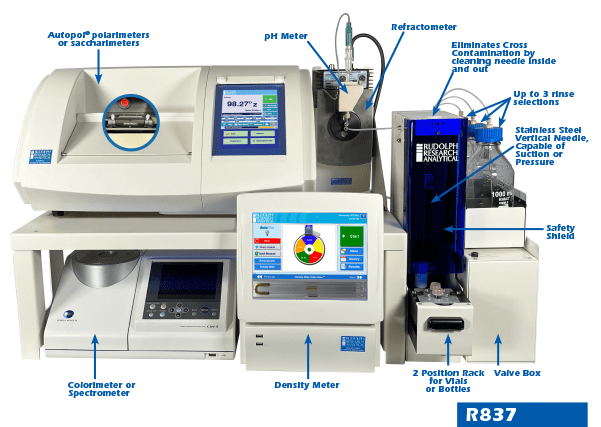
Manual vs. Automated Lab Workflow: A Fundamental Shift
In a conventional laboratory setting, a single sample may require three to five separate measurements. Each measurement involves a series of manual steps: loading the sample into an instrument, initiating the test, recording the result, and cleaning the system before proceeding to the next analysis.
This fragmented workflow results in repeated handling of the same sample across multiple instruments. Each step consumes time and introduces opportunities for inconsistency or error. On average, laboratories spend between 15 and 50 minutes processing a single sample through this manual sequence.
Automation fundamentally redefines this process. Instead of multiple interactions, the technician loads the sample once into an integrated system. The system then automatically routes the sample through all required analytical modules—refractometry, polarimetry, density measurement, pH analysis, and color evaluation—without further intervention.
This transforms a multi-step manual process into a continuous, streamlined workflow, reducing total analysis time to approximately 8–11 minutes per sample while eliminating redundant handling.
Intelligent Laboratory Sample Handling and Identification
One of the most impactful innovations in automated systems is the integration of sample racks and intelligent vial handling. Samples are placed into a carousel or rack that accommodates a wide variety of vial shapes and sizes, enabling batch processing.
For cylindrical vials, advanced systems can automatically rotate the vial to locate and read a barcode directly from its surface. This capability eliminates the need for manual data entry and ensures accurate sample identification throughout the analysis process.
The result is a significant improvement in traceability and data integrity. By removing manual transcription steps, laboratories reduce the risk of mislabeling, transcription errors, and mismatched results. At the same time, batch processing enables continuous, unattended operation, further enhancing efficiency.
Laboratory Labor: The Largest Hidden Cost
While capital equipment costs are often the focus of purchasing decisions, labor represents the most significant hidden expense in manual workflows.
In a typical scenario, a laboratory technician earning $30–$40 per hour may spend 15 to 50 minutes actively processing each sample. This translates to a labor cost of approximately $7.50 to $33.00 per sample. Importantly, this time is fully occupied—technicians cannot perform other tasks during this process.
Automation dramatically changes this equation. Once samples are loaded, the system operates independently, often processing 60 to 100 samples in a single batch. Technician involvement is reduced to a minimal level—primarily setup and occasional oversight—equating to roughly one minute of active labor per sample.
This shift frees highly skilled personnel to focus on higher-value activities such as data analysis, method development, and quality improvement initiatives, rather than repetitive manual handling.
Throughput and Operational Efficiency
The impact of automation on throughput is substantial. Manual workflows are inherently limited by the need for continuous technician involvement and sequential processing across multiple instruments.
In contrast, automated systems consolidate all measurements into a single process, reducing the number of sample interactions from three to five down to one. This simplification, combined with reduced cycle time, results in a three- to five-fold increase in throughput.
Additionally, automated systems can operate unattended, including overnight. This effectively extends laboratory capacity without increasing staffing levels, enabling organizations to handle higher sample volumes and meet tighter turnaround requirements.
Data Integrity and Error Reduction
Manual data handling introduces multiple points of vulnerability. Recording results by hand, entering data into spreadsheets or LIMS systems, and matching results to sample identifiers all create opportunities for error.
Common issues include transcription mistakes, incorrect sample labeling, and missing or incomplete data entries. These errors can lead to costly retesting, delays, or even compliance risks.
Automated systems address these challenges by integrating barcode-based sample identification with automatic data capture and export. Results are recorded digitally and can be seamlessly transferred to laboratory information systems, eliminating manual intervention and significantly reducing the risk of error.
The addition of automated barcode reading from spinning vials further strengthens traceability, ensuring that each result is accurately linked to its corresponding sample.

Instrument Consolidation and Simplification
Traditional laboratory setups often require multiple standalone instruments, each dedicated to a specific measurement. This not only increases capital investment but also adds complexity to daily operations, including maintenance, calibration, and cleaning.
Automated systems consolidate these functions into a single integrated platform. Samples follow one unified pathway, and cleaning cycles are performed automatically between analyses. This reduces redundancy, simplifies workflows, and minimizes the potential for cross-contamination or procedural variation.
Cost Considerations: Investment vs. Return
At first glance, automated systems require a modest increase in capital investment—typically 15–20% higher than purchasing multiple standalone instruments.
However, this incremental cost is quickly offset by labor savings. For example, in a laboratory processing 80 samples per day, annual labor costs may decrease from approximately $350,000 in a manual workflow to around $12,000 with automation.
This represents an annual savings of over $300,000, resulting in a payback period measured in weeks rather than years. Even lower-volume laboratories achieve rapid return on investment, with break-even points ranging from days to a few months depending on sample throughput.
Beyond Cost: Quality and Consistency
Automation not only improves efficiency but also enhances measurement quality. By standardizing sample handling and cleaning procedures, automated systems eliminate variability introduced by different operators.
This consistency is critical in industries where product quality and reproducibility are paramount. Automated workflows ensure that each sample is processed under identical conditions, improving reliability and confidence in analytical results.
The True Cost of Manual Sampling
The most significant drawback of manual workflows lies in the risks they introduce. Errors in measurement, data entry, or sample identification can lead to off-spec product, batch rejection, or regulatory non-compliance.
These events carry costs far beyond labor—impacting production schedules, customer satisfaction, and brand reputation. In many cases, a single significant error can outweigh the entire cost of implementing automation.
निष्कर्ष
Manual sample handling, while familiar and seemingly cost-effective, carries substantial hidden costs in labor, inefficiency, and risk. Automation addresses these challenges by transforming fragmented workflows into streamlined, integrated processes.
By reducing analysis time, minimizing human intervention, improving data integrity, and enabling unattended operation, automated systems deliver measurable improvements in both performance and cost efficiency. Ultimately, the true cost of manual sampling is not the equipment—it is the accumulated impact of time, labor, variability, and risk embedded in the process. Laboratories that recognize and address these hidden costs position themselves for greater productivity, reliability, and long-term success.
Frequently Asked Questions About Laboratory Sample Handling Automation
What is automated laboratory sample handling?
Automated laboratory sample handling uses a sample rack or carousel, pumps, software, and connected analytical instruments to move samples through a predefined testing sequence with minimal technician involvement. A single sample can be identified, measured, cleaned from the system, and its results recorded automatically without requiring the technician to manually load each instrument.
How much labor can laboratory sample automation save?
In a manual workflow, completing three to five measurements on separate instruments can require approximately 15 to 50 minutes of technician time per sample, including loading, measuring, recording results, and cleaning. With automation, active technician involvement may be reduced to roughly one minute per sample on average, primarily for loading the sample rack and starting the run, while the system performs the measurements and cleaning unattended. Actual labor savings will vary according to the number of measurements, sample type, laboratory workflow, and batch size.
When does laboratory automation pay for itself?
Payback depends primarily on sample volume, technician labor cost, manual handling time, and the additional cost of automation compared with purchasing standalone instruments. In one representative example using a $35 per hour technician rate, approximately 30 minutes of manual labor per sample, about one minute of active labor with automation, and an estimated $15,000 incremental investment, the labor savings are approximately $16.90 per sample. At those assumptions, the additional investment is recovered after roughly 888 samples.
How many samples are needed to justify laboratory automation?
There is no single sample-volume threshold for every laboratory because workflows and labor costs differ. Using the representative assumptions above, the break-even point is approximately 888 total samples. A laboratory processing 50 samples per day could reach that point in about 18 working days, while a laboratory processing 100 samples per month could reach it in approximately nine months. Laboratories should calculate their own break-even point using their actual labor rate, testing time, sample volume, and equipment costs.
Can one sample be used for multiple laboratory measurements?
Yes. A major advantage of laboratory automation is the ability to perform multiple analytical measurements from a single sample load. Depending on the system configuration and application, the same sample can be routed through instruments measuring refractive index, optical rotation, density, pH, and color. A laboratory may perform three, four, or all five measurements without requiring the technician to repeatedly load the sample into separate instruments.
Can laboratory automation run unattended overnight?
Yes. Once a rack of samples is loaded and the automated sequence is started, the system can continue processing samples with minimal supervision. Depending on the rack configuration and application, batches of approximately 60 to 100 samples can be processed unattended, allowing laboratories to continue testing during breaks, after normal working hours, or overnight.
How does barcode sample identification reduce laboratory errors?
Barcode identification links the sample ID directly to the analytical results without requiring the technician to type or transcribe the identification manually. With cylindrical sample vials, the automation system can rotate the vial until the barcode is located and read automatically. This saves technician time while reducing the risk of mistyped sample IDs, mismatched results, transcription errors, and other data-integrity problems associated with manual recordkeeping.
Does laboratory automation reduce operator error and improve measurement repeatability?
Yes. Manual testing can introduce variability when different technicians load samples, clean instruments, or follow slightly different handling procedures. Laboratory automation applies the same programmed sample loading, measurement, and cleaning sequence each time, helping reduce operator-dependent errors and improve consistency from sample to sample. By standardizing the method, automation can support more repeatable measurement results and reduce the risk of problems caused by incomplete cleaning, inconsistent sample handling, or manual procedural differences.
