
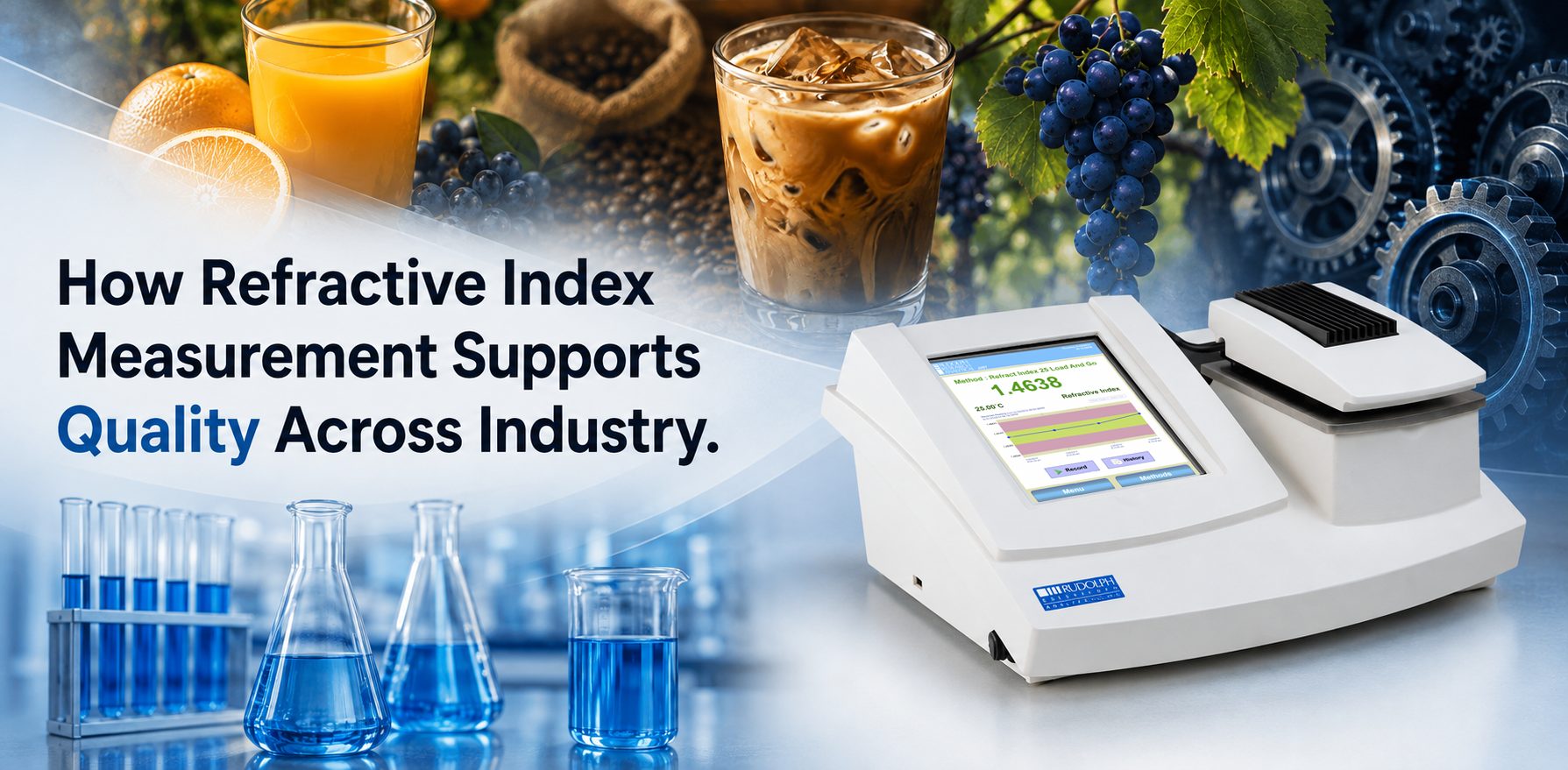
How Refractive Index Measurement Supports Quality Across Industry
Brix: A Familiar Term with a Much Broader Meaning. Ask someone in the food industry what “Brix” means, and the answer will likely be “sugar content.” While that answer is rooted in history, it no longer tells the whole story.
Today, Brix is one of the most widely used quality-control measurements in manufacturing. Beverage producers use it to verify syrup concentrations. Coffee manufacturers monitor extraction strength. Maple syrup producers ensure proper finishing concentration. Honey processors evaluate moisture content. Tomato processors control evaporation, and wineries use Brix to estimate grape maturity before harvest.
In all of these applications, laboratories are not directly measuring sugar. Instead, they are measuring a physical property known as refractive index and converting that measurement into a familiar and meaningful scale.
Related Technical Resource – Refractometry
For a detailed discussion of refractive-index principles and measurement, see Rudolph Research Analytical’s Measuring Refractive Index—Refractometry technical guide. Please see: https://rudolphresearch.com/measuring-refractive-index-refractometry/
Modern electronic refractometers have transformed Brix measurement from a simple laboratory test into a powerful tool for process control, product consistency, and quality assurance. This paper explores how Brix evolved from a measurement of sucrose solutions into one of the most versatile quality-control tools used across today’s food, beverage, agricultural, pharmaceutical, and chemical industries.
From Sugar to Quality Control
The Brix scale has a simple historical definition.
One degree Brix (°Bx) represents one gram of sucrose dissolved in one hundred grams of solution. For pure sugar-water mixtures, this relationship remains accurate and is still used throughout the world.
However, modern manufacturing rarely deals with simple sugar solutions.
Today’s products contain combinations of sugars, acids, proteins, salts, flavor compounds, minerals, alcohols, and hundreds of other dissolved materials. Yet manufacturers continue to rely on Brix because it provides a rapid, repeatable indication of product concentration and consistency.
For many production environments, maintaining a consistent Brix value from batch to batch is far more important than determining the exact amount of sucrose present.
As a result, Brix has evolved from a measurement of sugar concentration into a practical indicator of manufacturing consistency.
What Is Really Being Measured?
One of the most common misconceptions about Brix is that a refractometer “measures sugar.”
It does not. A modern refractometer measures refractive index—the way light changes direction as it passes from air into a liquid.
Dissolved substances can change the optical properties of a solution, with the magnitude of that change depending on the substance, concentration, temperature, and sample composition. As concentration changes, refractive index changes as well.
The instrument measures refractive index and applies a mathematical conversion to display the result on the Brix scale. In products other than pure sucrose solutions, this value is often described as apparent Brix because other dissolved substances also influence refractive index.
Understanding this distinction helps explain why refractometers have become valuable in industries far beyond sugar production.
The science behind Brix measurement has developed over more than two centuries. What began as an effort to understand how light travels through different materials eventually became a fast, precise, and highly automated tool for industrial quality control.
The Evolution of BRIX Measurement
From Sugar Solutions to Global Quality Control
For more than 200 years, the measurement of refractive index has evolved from scientific discovery into one of the most valuable tools for process control and product quality

1811 THE DISCOVERY
Thomas Young publishes experiments showing that light changes direction when passing through different substances.
The foundation of refractometry begins.

1820’s EARLY INSTRUMENTS
Sir David Brewster designs on of the first practical refractometers, allowing scientists to measure refractive index with greater accuracy.
Refractometers move from theory to practice.

1870 BRIX SCALE INTRODUCED
Adolf Brix develops the Brix Scale, defining 1 °Bx as one gram of sucrose in 100 grams of solution at 20°C.
A simple practical scale for sugar solutions is born.

1930’s-1950’s INDUSTRIAL ADOPTION
Optical refractometers become widely used in sugar refineries, food processing, and beverage production around the world.
Brix becomes the standard for quality control.

1970’s-1990’s DIGITAL INNOVATION
Electronic refractometers replace manual reading with digital detection and temperature compensation, improving accuracy and repeatability.
Measurements become faster, easier, and more reliable
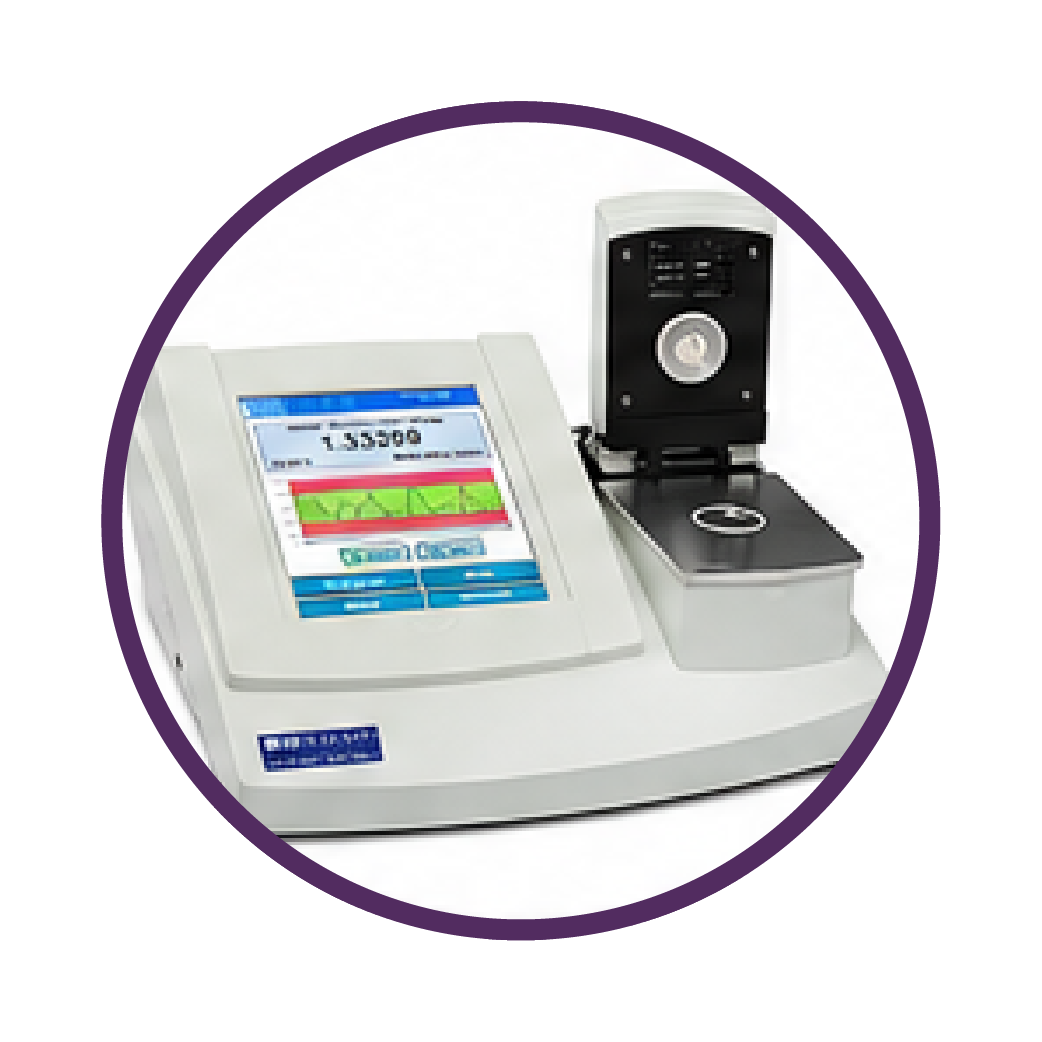
2000’s to TODAY MODERN REFRACTROMETRY
Advanced digital refractometers offer automatic temperature control, connectivity, LIMS integration and automation for today’s quality-driven industries.
Refractometry powers quality, efficiency and innovation worldwide.
Why Brix Has Become the Language of Process Control
Manufacturing depends on consistency.
Consumers expect every bottle of orange juice to taste like the last one. Every batch of maple syrup should have the same texture. Tomato paste should deliver the same concentration every time it is used in food production.
Brix provides operators with a simple numerical value that quickly indicates whether a process is operating within specification.
Rather than waiting for lengthy laboratory analyses, production personnel can obtain results in seconds and make immediate adjustments when necessary.
This speed has made Brix one of the most practical process-control measurements available.
Brix Applications Across Modern Industry
Fruit Juice

Fruit naturally varies throughout the growing season. Weather, rainfall, soil conditions, and harvest timing all influence sugar concentration.
Juice processors routinely measure Brix to blend products consistently and maintain a uniform taste regardless of seasonal variation.
Without these measurements, every production batch could taste noticeably different.
Soft Drinks

Most carbonated beverages begin with highly concentrated syrup formulations.
Maintaining the correct syrup concentration is essential because even small variations can influence sweetness, flavor balance, carbonation, and consumer acceptance.
Routine Brix measurements verify that syrup preparation and final dilution remain within specification.
Coffee Concentrates

Ready-to-drink coffee and cold brew products have become one of the fastest-growing beverage categories.
Manufacturers monitor Brix throughout extraction to maintain a consistent concentration from batch to batch.
Accurate measurements help ensure that every bottle delivers the same flavor profile while minimizing product variability.
Maple Syrup Production

Maple syrup producers rely heavily on Brix measurements.
If finished syrup contains too little dissolved solids, microbial growth and spoilage become more likely.
If concentration is too high, sugar crystals may form during storage.
Maintaining the proper Brix range improves both product quality and shelf life.
Flavor & Fragrances

Flavor and fragrance manufacturers rely on refractometry to help verify the identity, concentration, and consistency of essential oils, aroma compounds, extracts, and blended formulations.
Because many flavor and fragrance materials have characteristic refractive index ranges, a measurement that falls outside the expected specification may indicate dilution, contamination, an incorrect raw material, or a blending error.
Refractometry also provides a fast way to compare incoming materials, monitor production batches, and confirm that finished formulations remain consistent from lot to lot.
Honey Processing

Honey quality is closely related to moisture content.
Although refractometers measure refractive index rather than moisture directly, industry conversion tables allow producers to estimate moisture quickly.
Proper moisture levels reduce fermentation, improve storage stability, and support product grading.
Tomato Products

Tomato paste, puree, ketchup, and sauces are sold according to concentration.
During evaporation, processors continuously monitor Brix to determine when the desired concentration has been achieved.
Accurate measurements improve consistency while avoiding unnecessary processing time and energy consumption.
Brewing & Winemaking

Brewers and winemakers have long relied on refractometry.
Brewers frequently monitor wort concentration before fermentation, while winemakers measure grape maturity to estimate potential alcohol production.
Although brewing often reports results in degrees Plato, refractometry remains an essential analytical technique throughout beverage production.
After fermentation begins, the presence of alcohol affects refractive index. Brewers and winemakers may therefore use correction models or a complementary analytical method when interpreting readings from fermenting or finished products.
Dairy Products

Sweetened condensed milk and other concentrated dairy products require careful control of dissolved solids.
Routine Brix measurements help manufacturers maintain product consistency while meeting formulation specifications.
Confectionary & Syrups

Candy, jams, jellies, and syrups all depend upon precise concentration control.
Small changes in Brix can significantly affect texture, appearance, crystallization, and shelf stability.
For these manufacturers, Brix is an essential production measurement.
Pharma & Nutraceuticals

Many pharmaceutical syrups, nutritional supplements, and liquid formulations require consistent concentration throughout manufacturing.
Refractometry provides a rapid, non-destructive measurement that supports batch-to-batch consistency and process verification.
Industrial & Other

• Monitor coolants and lubricants
• Check glycols & solvants
• Support many other industrial solutions
More than Brix
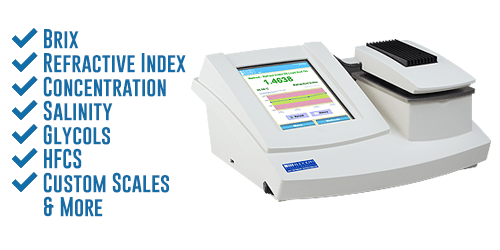
Modern refractometers measure refractive index and display results in a variety of scales including:
Why Modern Digital Refractometers Have Changed the Industry
The principles of refractometry have remained constant for generations. The technology used to perform the measurement has changed dramatically. Traditional optical refractometers require the operator to place a sample on a prism, manually observe a shadow line, and determine the measurement visually.
Although these instruments remain useful in many applications, results can vary depending on operator experience, lighting conditions, and interpretation. Modern digital refractometers eliminate this subjectivity.
The underlying scientific principle has not changed, but the way measurements are performed, controlled, documented, and transferred has advanced substantially. The following comparison illustrates the practical differences between traditional optical instruments and modern digital refractometers.
Traditional Optical vs. Modern Digital Refractometry
While both technologies measure refractive index, digital instruments improve repeatability, automation, electronic data handling, and laboratory productivity.
Traditional Optical Refractometer
Modern Digital Refractometer

Visual shadow-line reading
Operator looks through eyepiece and aligns shadow line

Automatic electronic detection
High-resolution optics detect and measure instantly

Operator interpretation
Results can vary based on experience, lighting and eyesight.

Objective, repeatable results
No subjectivity every measurement is calculated the same way


Manual temperature correction
Must measure temperature separately and apply correction factors.

Automatic temperature control
Built-in Peltier temperature control ensures fast stability and accuracy.


Handwritten result recording
Results written by hand & transferred to notebooks or LIMS.

Electronic data capture & storage
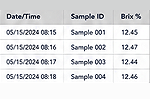
Results stored automatically with date, time, operator, method, and sample ID.

Limited Scale Selection
Typically one scale at a time with manual conversion

Multiple scales & custom methods
Switch scales instantly: Brix, RI, salinity,glycol,HFCS, custom scales and more.


Stand-alone measurement
Data must be transferred manually for integration or analysis.

Connectivity & automation ready
USB, Ethernet, and LIMS integration, built for industry 4.0 and regulated environments.

