
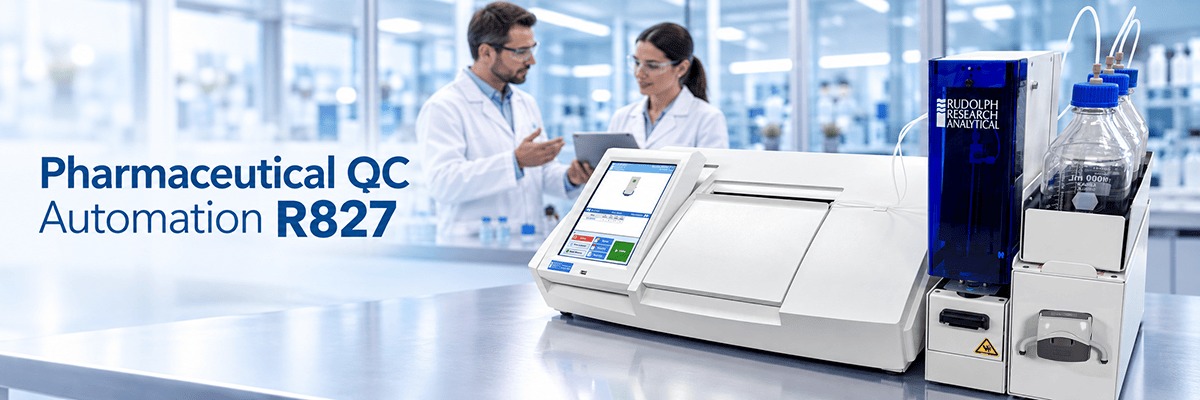
AutoFlex® R827 Pharmaceutical QC Automation
Automate Everything Around the Measurement.
Standardize sample identification, loading, measurement, rinsing, drying and result transfer for pharmaceutical specific-rotation and physical-property testing.
Blank + Sample
One programmed drawer workflow
Automatic Cleaning
Configurable rinsing and drying
Connected Results
LIMS, SAP and network capable
Expandable Testing
Up to six analyses by configuration
The measurement is only part of the workflow
Bring greater consistency to the manual steps surrounding pharmaceutical analysis.
A validated analytical method can still depend on repeated operator actions: identifying the sample, loading the cell, running the blank, rinsing, drying, recording the result and preparing the instrument for its next use. The AutoFlex R827 is designed to automate those surrounding steps in a controlled, repeatable sequence.

Standardize the Sequence
Program sample loading, measurement, cleaning and drying parameters so the workflow is performed consistently.

Reduce Manual Handling
Move repetitive preparation and cleanup steps away from the analyst while preserving the established measurement principle.

Connect Sample to Result
Use sample identification and electronic result transfer to reduce opportunities for manual transcription.

Leave the System Ready
End the programmed operation with cleaning and drying so the instrument is prepared for the next workflow.
A practical pharmaceutical starting point
Automated specific-rotation testing—from blank through final cleaning.
Pair the two-sample R827 drawer with a Rudolph polarimeter to automate the blank and sample sequence in one programmed operation.
1. Identify
Associate the sample ID with the programmed method and resulting record.
2. Measure Blank
Load and measure the blank according to the defined workflow.
3. Rinse
Run the configured rinse and drying routine between blank and sample.
4. Measure Sample
Load the pharmaceutical sample and complete the specific-rotation measurement.
5. Clean + Dry
Finish with the programmed cleaning cycle and prepare the system for its next use.
Designed around pharmaceutical QC priorities
Support a more controlled and traceable laboratory workflow.
The R827 brings automation to physical-property testing without changing the analytical principle behind the measurement. Depending on the selected configuration, the system can help laboratories:
- Standardize sample-loading, rinsing and drying procedures
- Reduce operator-to-operator differences in routine handling
- Associate sample identification with measurement results
- Transfer results to LIMS, SAP, a network server or another data system
- Reduce repetitive cleaning and manual transcription tasks
- Define method-specific measurement and cleaning parameters
Compliance note: The R827 provides capabilities that can support a laboratory’s data-integrity and controlled-workflow strategy. Overall compliance depends on the complete configured system, validation, procedures, access controls, training and intended use.
One platform, application-specific configurations
Begin with specific rotation—or automate a broader physical-property workflow.
R827 drawer and carousel configurations allow Rudolph to match the automation system to the method, sample vessel, sample volume and throughput needs of the laboratory.
| Configuration | Best suited for | Pharmaceutical value |
|---|---|---|
| Two-Sample Drawer + Polarimeter | Blank-and-sample specific-rotation workflows | Automates the complete sequence, including final cleaning and drying, in one programmed operation. |
| Drawer + Additional Instruments | Focused physical-property testing with a compact sample queue | Extends automation beyond polarimetry based on the required measurements and system design. |
| Carousel Configuration | Higher sample counts, varied vessels or more complex queues | Provides configurable racks, optional barcode identification and automated sample handling for repeat testing. |
| Multi-Instrument System | Density, refractive index, optical rotation, color, pH or other compatible analyses | Generates multiple physical-property results from an identified sample and exports the resulting data electronically. |
Available measurements, sample capacities, vessels, loading modes, barcode options and data connections vary by configuration. Rudolph will review the intended application before recommending a system.
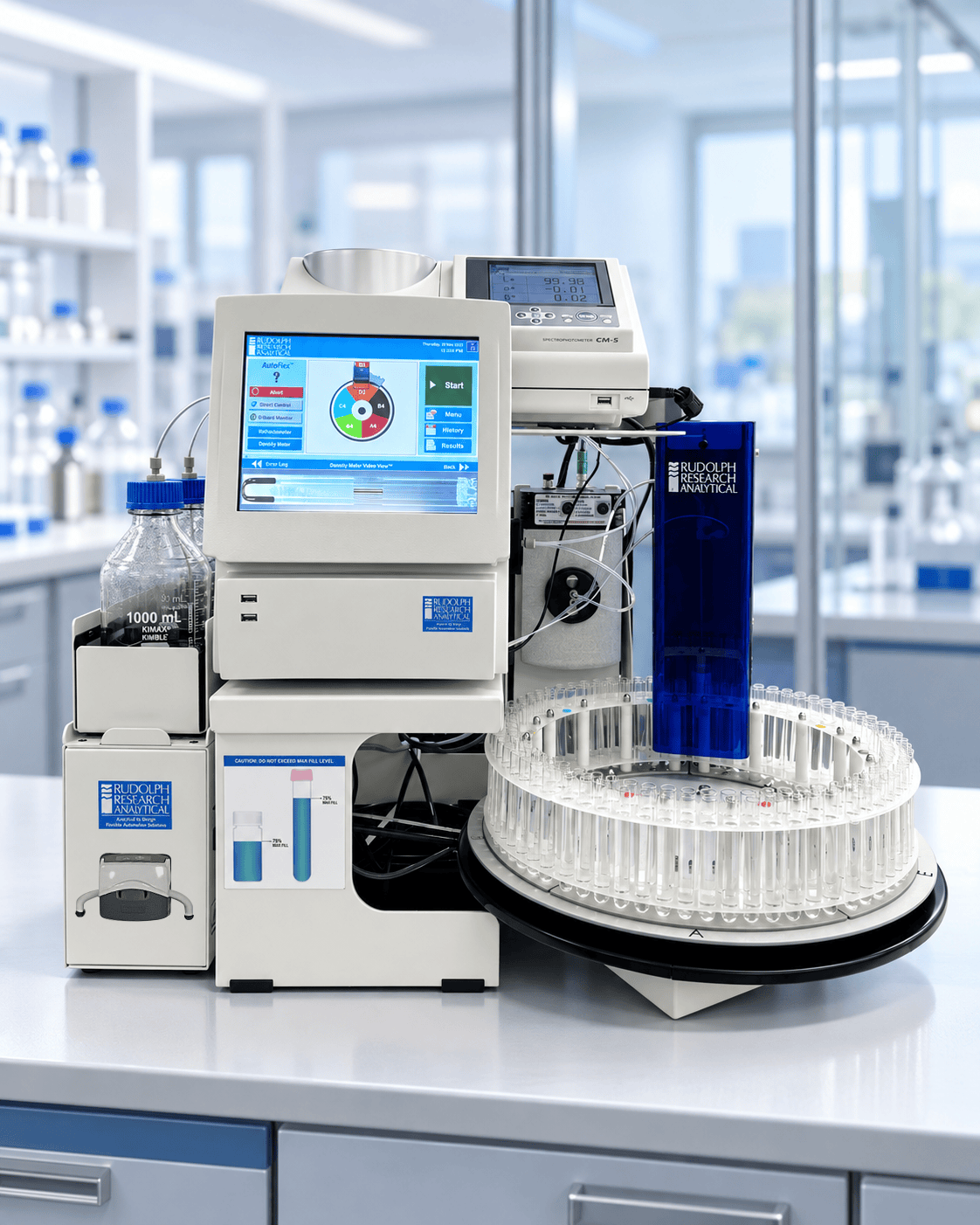
Beyond a single measurement
Build a workflow around the results your laboratory actually needs.
Many pharmaceutical laboratories perform more than one physical-property test on incoming materials, intermediates or finished products. Based on the configuration, the R827 can be paired with compatible instruments for analyses including:
- Optical rotation
- Specific rotation
- Density and specific gravity
- Refractive index
- Color measurements
- pH measurements
Instead of selecting a system from a generic package, Rudolph can review the method, sample type, viscosity, vessel, cleaning agents, sample volume, throughput and data destination to develop an application-specific configuration.
A fit for demanding analytical environments
Where pharmaceutical laboratories can apply R827 automation.
API and Chiral-Compound Testing
Automate routine blank, sample, rinse and drying steps surrounding optical- and specific-rotation measurements.
Raw-Material and Excipient QC
Support repeat physical-property testing for incoming materials using defined sample-handling and measurement routines.
Liquid Drug Products
Configure automated density, refractive index and other compatible measurements for oral solutions and other liquid products.
Release and Stability Testing
Increase consistency across recurring methods and sample sets while reducing repetitive analyst interaction.
CDMO and Contract Laboratories
Support varied client methods with configurable sample handling, cleaning parameters and electronic data export.
Method Development and Transfer
Define repeatable automated workflows that can support the transition from development into routine use.
Application review
Automation should begin with the method—not the hardware.
A productive R827 evaluation starts by documenting the work the analyst performs before and after the measurement. Rudolph can review:
- Required measurements and acceptance criteria
- Blank, standard and sample sequence
- Daily sample count and priority-sample needs
- Sample viscosity, temperature and available volume
- Current sample vessels and labeling
- Rinsing agents, cleaning sequence and drying time
- Existing instruments and laboratory data systems
- Qualification, validation and documentation expectations
Recommended next step
Request a Pharmaceutical Workflow Review
Share your method, sample type or current manual process. Rudolph will help determine whether the two-sample drawer, a carousel or a multi-instrument R827 configuration is the right fit.
For immediate assistance, call 973-584-1558 or email info@rudolphresearch.com.
Frequently asked questions
Planning an R827 pharmaceutical configuration
Why lead with the two-sample drawer for pharmaceutical laboratories?
It directly addresses a common polarimetry workflow: measuring a blank and sample in one programmed operation, followed by automated cleaning and drying. It provides a focused way to introduce automation without requiring a high-volume carousel.
Can the R827 automate measurements other than specific rotation?
Yes. Depending on the selected configuration, the R827 can be paired with compatible instruments for measurements such as optical rotation, density, specific gravity, refractive index, color and pH.
Can results be transferred to our laboratory data system?
R827 configurations are LIMS, SAP and network capable. The exact interface, file format, mapping and validation requirements should be reviewed for the laboratory’s selected instruments and data environment.
Does the R827 make a laboratory compliant with 21 CFR Part 11?
No individual instrument or automation component makes an entire laboratory compliant by itself. The configured system may provide features that support controlled and traceable workflows, but compliance depends on the full computerized system, validation, procedures, user management, record controls, training and intended use.
How is the right configuration selected?
Rudolph reviews the measurement method, sample properties, volume, throughput, vessel, cleaning process, current instruments and data requirements before recommending a drawer, carousel or multi-instrument configuration.
Automate everything around the measurement
See how the R827 can fit your pharmaceutical QC workflow.
Bring Rudolph your method, sample requirements and current manual steps. We’ll help define an automation approach around your actual laboratory process.
